News and updates from Paul and Cathy Middleton, serving in southern Africa.

08 September 2019

Flying for Life - Limpopo

It can get quite hard to realise the affect that your actions have when you repeat them often.

We have flown in support of MAF and Flying for Life many times the past few years and each time is always a big day out. The paperwork and flight plans are filed in the preceding week and we often take the aircraft to a local airport with runway lights the day before and fill it up with fuel. The day of the flight I get up just after 03:30 to drive to the airport where we do pre-flight checks before taking off in the dark, bound for Johannesburg. In the depth of winter (July) we land in Jhb just before the sun rises.
 
There we meet our passengers, load their supplies and can be on the ground for as little as 20 mins before setting off once again for Thohoyandou in the Limpopo province, almost two hours flying away. Once there, we unload before an hours drive to the hospital the team are working in.
There the patients are already waiting, usually prepped and ready for their life changing surgery that will restore sight to their eyes. This will not only affect them of course, but countless others in the communities such as families that rely on them to look after children while they are out at work or tending the fields.
The first lady was 95 and lived only three doors down from the hospital
Last Saturday we were again flying a team of nurses, doctors and surgeons to this hospital. Unfortunately eye issues are not seen as a priority by the department of health, after all, no one dies from blindness. This is reflected by the fact that in Limpopo, a province six times the size of Wales and with a population of 5 million people, there are only two hospitals equipped to offer eye cataract surgery. Our efforts to take specialists to Thohoyandou increased this number to three, but only of course for one day per month. The other sad fact is that people that were seen by our team were diagnosed as needing the treatment in January of 2017!
Proff uses a Schiotz Tonometer to measure eye pressure
The team are dedicated and compassionate and work tirelessly from the minute they get there till the last possible moment before we have to drive back to the airstrip in order to safely get airborne before the sun sets. This ensures that the maximum number of people have the chance to benefit from their expertise.

Fortunately I was able to use a private room at the hospital to get some rest before the long trek back. Within minutes of taking off it was dark, but the clouds that had made the morning trip up interesting, had cleared and there were no delays to our landing back in Jhb. As the team began their drive home, I refuelled the plane and then set back off into the night for the last 1h30 flight to where I had begun the day, or at least to the local airport with runway lights, where I put the plane to bed before driving up the hill to arrive at my house and a very welcome cup of coffee just before 22:30.
The bright lights of Jhb from 11000'
So, 'a grand day out' as Wallace and Gromit would say, but quite insignificant when compared to the extra lease of life given to the many people whose lives have been changed, and the many more who will benefit in the rural communities from their renewed sight.

Thank you

Paul and Cathy

01 June 2019

Cyclone Idai - Part Two


As a follow on to the previous blog entry:


Cyclone Idai made landfall in mid-March bringing heavy rain and winds of 170kph.
From this next comparative map you can see that the cyclone was almost the size of the UK.
Flooding was extensive and at one point an inland sea of 2000sq km had formed just inland from Beira.
In the middle of the next photo you can just see the town of Buzi emerging from the floods in one of the worst affected areas.
People there were left with few options for survival...
..and flying overhead we found people stranded on roofs.
 
Apparently there were crocodiles swimming up and down the streets!
In the more rural areas people had no choice but to climb trees and many were lost as they couldn't hang on for more than a few days.
As the initial search and rescue phase closed, focus then turned to relief. Our helicopters were able to land on the first bits of land to dry out to assess the situation.


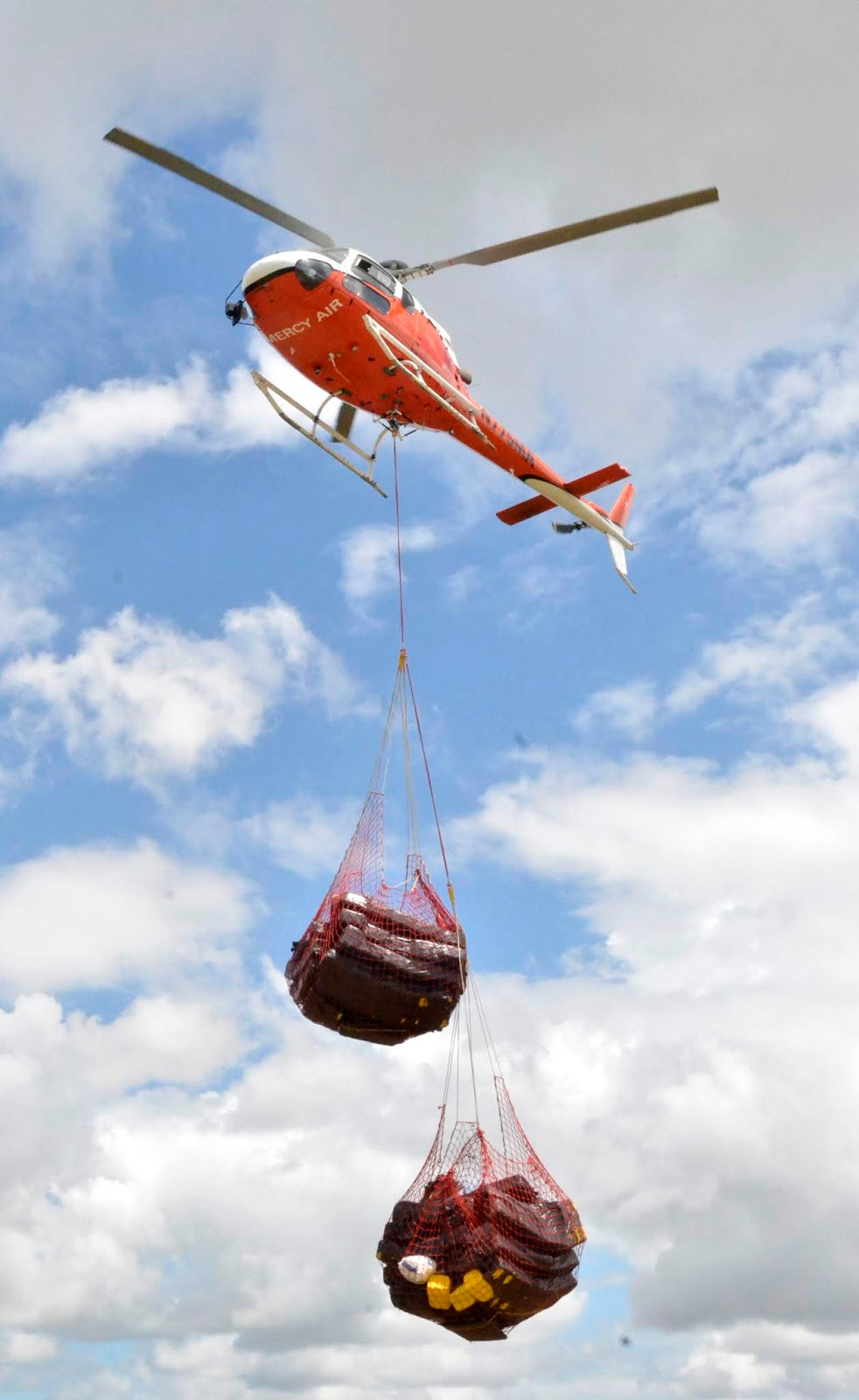
They were able to bring in the first food and supplies.


We met a team from Samaritan's Purse, an organisation headed up by Billy Graham's brother, Franklin Graham, to offer support in times of disaster. We agreed to help them by flying doctors, nurses and medical supplies to a field hospital they had set up in Buzi. For us it was a 13 minute flight but when the road was eventually cleared it was still a 4-5 hr drive.

When they heard that Cathy was a nurse and midwife they asked if she would join them. On our next trip up Paul dropped Cathy off at the newly cleared (and drying) Buzi airstrip.
The hospital is the white tents
We had to take a dodgy boat across the river.
..and walk to the hospital past houses showing a high water mark 2 meters up all the houses.

 
At the hospital Cathy was straight to work.


Next door the original hospital's maternity unit had spread all the records out to dry.
Paul then left and spent the rest of the week flying nutritional food and water purification tablets, amongst other things, to various other places.


A few times during the week when Paul dropped off other supplies, we got to meet up for half an hour.
We did our last relief flight almost two months after the cyclone first hit, and Mercy Air's four aircraft flew an equivalent of 1.7 times round the world.

We have now finished  our immediate involvement with the relief operations, but for the people living in the affected areas the struggle will still go on for months, years or even most of their lifetimes.

Thank you

Paul and Cathy

09 April 2019

Cyclone Idai

As most people know, Cyclone Idai hit central Mozambique recently.
The main bit of the cyclone is about 2/3 the size of the UK
Strangely enough this was the storms second pass. The first time (the blue dots below) as a tropical depression, it caused a lot of flooding in Malawi and caught Paul at the end of his week with YWAM team in Marromeu on the Zambezi (see previous blog post).
The second time was far more destructive and has been described as the worst weather disaster to affect the southern hemisphere. The photos of the devastation and flooding were widely seen on TV and the internet.
People spent many days on rooftops...


..and in trees
An inland sea was created of 2000sq kilometers and about 1.7 million people were affected across Mozambique, Zimbabwe and Malawi.
Mercy Air already had a helicopter in Beira and we went up the day before the storm to move it inland to a less risky place.

This meant that it was the first on the scene after the storm had cleared. It worked tirelessly every day helping to locate and rescue people totally cut off and without food and water.
Mercy Air's fixed wing aircraft got involved by flying relief supplies up from South Africa as well as enabling heli crew rotation. Our second heli joined a week later. Our office soon took on the semblance of a warehouse.
One company, Universal, donated 2.5 tonnes of a nutritional food supplement which we were able to deliver to various locations with our Quest Kodiak.

The Cessna 310 was used for smaller loads and crew supplies.
Supplies for the YWAM team and the orphanage in Beira

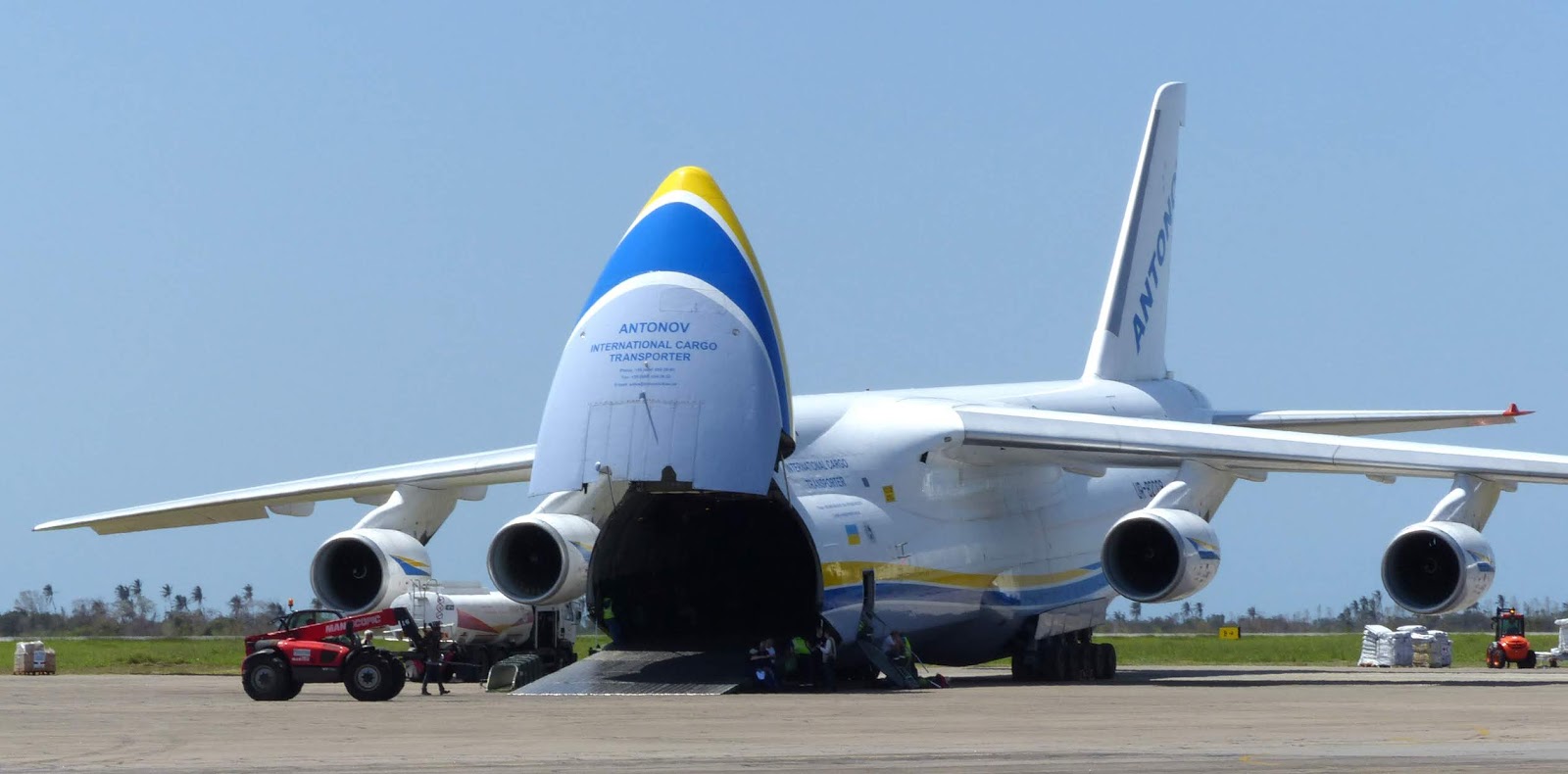
It seemed to take a while, but eventually we began to see the international aid community pitch up with some serious heavy metal. The usually quiet airport in Beira has turned into something of a plane spotters paradise.
The Royal Air Force with an A400M
A ridiculously big (and noisy) Antonov 124.


That's a slim looking Boeing 747 cargo in the background
Paul talked his way onto a USAF Hercules and an Antonov 12 - very Russian and quite scary!
Much of the water has receded now and the initial rescue operation has moved into a relief mode. The need for flying is still as great as ever and the battle is now as much with malaria and cholera as it is with hunger and shelter. Food and non food items are being airlifted daily.

Cathy and I will go up again this week to take food supplements and then again next week to work in a field hospital set up near the recently cleared Buzi airstrip in one of the worst affected areas.

Thank you

Paul and Cathy