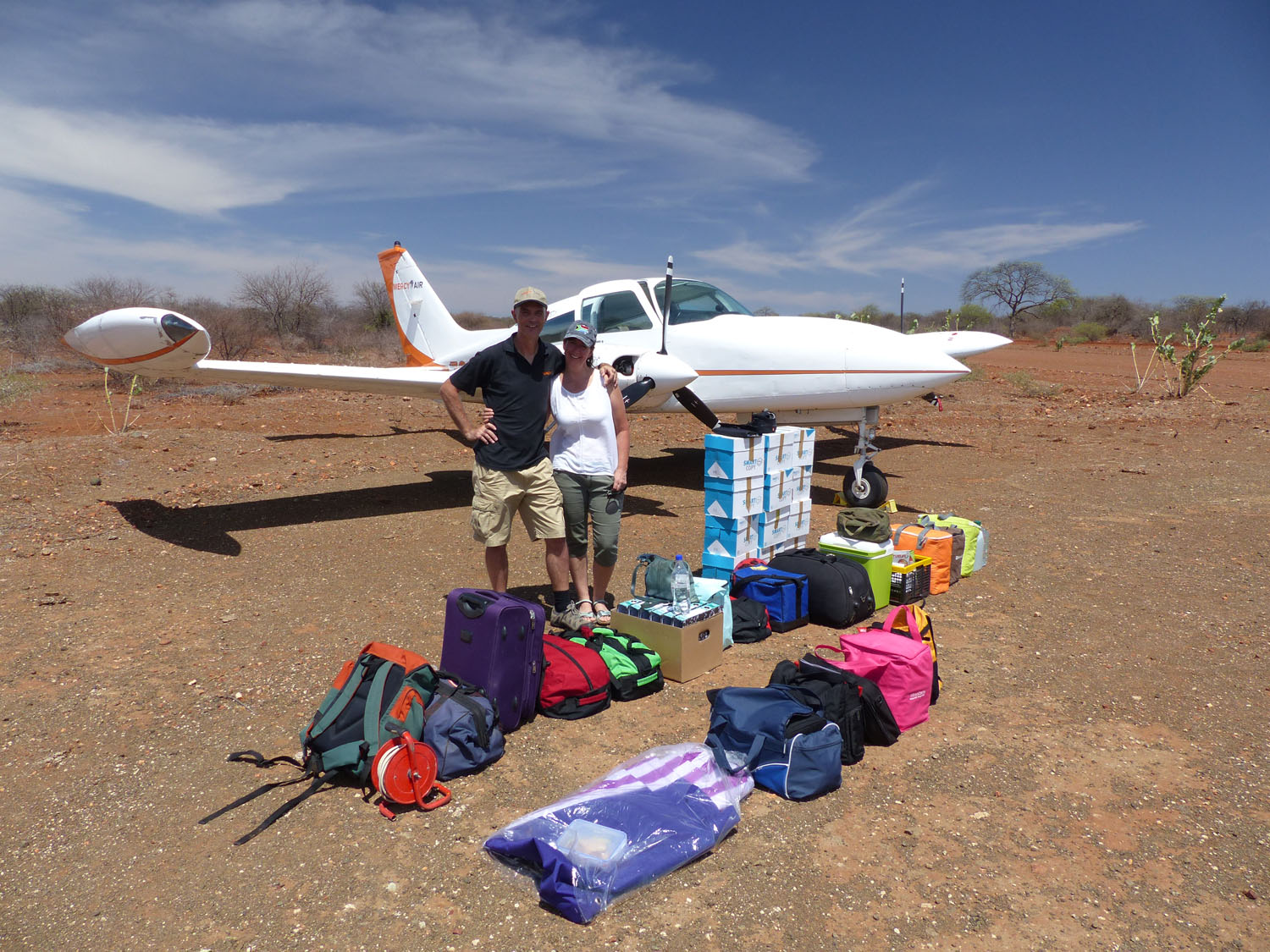
In late November Cathy and I flew the Mission Aviation Fellowship/Flying For Life/Love Trust team up to the Vhemba district of South Africa for a week.
It might not look much on the map the red line represents flying twice the length of the UK.
We took off just after dawn in the cool of the day and enjoyed seeing clouds and mist in the valleys beneath us.
I always consider it a compliment when my passengers sleep during the flight. Even my co-passenger slept although I wasn't allowed to use that picture!
As we came in to land at Tshikondeni in the very north east of South Africa, we began to realise just how much affect the drought was having.
We parked and unloaded the supplies we had bought for the week.
There was quite a lot of stuff for a little plane.
From here it was all driving on endless dusty dry roads. By the end of the week we'd clocked up over 900km.
The team we had bought up were working into local schools and particularly the pre-schools. One lady was running a course in early childhood development training for existing teachers. We drove her to a rather run down community centre each day where she just got stuck into training/teaching.
Then we headed off down more endless dirt roads to other schools where other members of the team observed, assessed and gave help where necessary to recently qualified teachers.
In between two schools we did divert off to follow a sign that advertised a 'Big Tree'.
I suppose we shouldn't have been too suprised to find a rather large Baobab just beyond a car park at the end of the track.
It is supposedly 3000 years old and has a 16m diameter, 47m trunk circumference.
At the next school one of our jobs was to install a curtain that had been specially made to prevent dust (and occasionally rain) from blowing in through the security bars on onto the kids inside.
I managed to get some wire bending help from one of the kids.
The temperatures decided to get hotter than most Gulf states for this particular week (40 deg-ish) which was bad news for people and animals alike although we were grateful we could still buy water and food. Everywhere we went there were cows and goats huddled in the shade of trees doing nothing - they couldn't even eat grass because there was none.
The place we stayed at was a saving feature of the week mainly due to the fact that the huts had comfy beds, a shower and air-con. Extra excitement was also provided by the discovery of an unwelcome visitor in our bedroom the first morning.
The wildlife viewing didn't stop there as it seemed the local communities cattle also had access to the pool area.
An organisation in Johannesburg had made a large number of sturdy wooden cars which we bought up in the plane for the school kids. Each day we took some boxes full to the schools and gave them out.
It was amazing to see just how excited the kids got at the arrival of these simple toys.
We were very impressed at how controlled they were in taking it in turns to play with them.
Then it was back down more Baobab lined dirt roads...
... to the next school where the children again seemed happy to see us - maybe they were just laughing at us!
One child at this school had once been seen by a white doctor a while back when she was ill and now seemed petrified by any Mzungu. Lots of tears and gnashing of teeth!
At yet another school it was time for some swing maintenance in the playground...
...as well as some more cars.
After each days school visits we returned to the community centre to pick up the teacher and drop the students off.
 |
| In contrast to a muffin top, could this be a 'muffin bottom'? |
Most evenings we were back in time for a short walk through the sandstone outcrops...
...and have a look at some of the bushmen paintings.
 |
| We weren't too sure whether the bushmen of old saw an elephant, an ant eater or a long nosed mouse! |
The very last rays usually produced a nice sunset.
At one of the last schools we visited they were preparing for their 'graduation' and the kids took it in terns to do a final dress rehearsal of their present to us.
Then as soon as it had arrived it was time for us to go. A reprise of dusty dirt roads led us to the aircraft and the flight home.
Thank you
Paul and Cathy..
..and many children in north east South Africa