News and updates from Paul and Cathy Middleton, serving in southern Africa.

25 March 2012

Accommodation in Mozambique

In a recent post I was working on a container that the helicopter uses for fuel storage in Mozambique.

Obviously the places Mercy Air go are often are pretty far away from the flight base in South Africa and it's not possible to return every day. Therefore a trips can sometimes last up to 14 days. Now four containers have been positioned in Marromeu for the crews and mission teams.

For the past five years, Mercy Air has operated in the small town of Marromeu in Mozambique, on a regular basis. From there the Zambezi Delta stretches out over 10,000 m² to the Indian Ocean in the east. The area is very remote and doesn't have any infrastructure. That’s the reason the people who live there are dependent on support from the air.

With temperatures soaring to over 40 deg during the day and barely dipping below 25 deg at night, it is necessary to have comfortable accommodation for the crew. As there is no hotel or guest house in the whole area the Mercy Air staff were able to stay with a YWAM couple in their own house. But the couple have now moved away. We didn't want to give up our flight programe in the area and therefore we decided to position three living quarter containers along with another storage container in Marromeu.

Mercy Air has obtained and re-fitted these containers in South Africa.

One is for accommodation
one a kitchen...
and the other has laundry and ablution facilities.

Last week two flat bed trucks arrived at the farm
together with a huge crane whose use was kindly donated by Lowveld Mobile Crane Hire.
It took the best part of a morning to load the containers
before they started their long journey across the border and up to Marromeu.

Paul and Cathy

20 March 2012

Quest Kodiak joins Mercy Air fleet

Thanks to generous donors from the United States, the Mercy Air fleet has expanded by one more aircraft.

The Quest 'Kodiak' is currently being refitted in the USA and prepared for service in Africa.

Mercy Air's old Beech 18

After the sale of Mercy Air's 50 year old Beech 18 aircraft a few years ago, we started approaching foundations, companies and private individuals for donations for a replacement turboprop aircraft. Those efforts have been rewarded as a Kodiak has now been added to the Mercy Air fleet.

It is currently being refitted in the US to bring it up to the specifications required to serve in Africa and to prepare it for the long ferry flight across the Atlantic.

Designed especially for the demanding environment of third world countries, the Kodiak has exceptional flight characteristics and load carrying capabilities and a modern Garmin 1000 avionics suite.
Kodiak cockpit

The Kodiak was produced by Quest Aircraft in Idaho (USA) and is a very robust and multifunctional aircraft. It is especially designed for rough, unimproved remote airstrips. The three tone plane is equipped with a powerful Pratt & Whitney turbine engine which runs on Jet Fuel, which is cheaper and more readily available in Africa. It has excellent short take of and landing characteristics but also good cruise speed and load carrying capabilities, being able to seat 10 people.

With this aircraft come new possibilities for Mercy Air. An operating distance of 2000 km will allow Mercy Air to provide cost effective services and relief on a regular basis to more mission stations. Very soon we will have the opportunity to fly larger teams to help people in need.

Paul and Cathy

27 February 2012

Marromeu Education and Health

This years cyclone season seems to be in full swing and we have had to rearrange and even cancel a few flights. It was with some relief, then, that that Paul went back up to Marromeu in Mozambique recently with an Education Ministry Team.
The team then drove up to the new YWAM base in Nensa whilst Paul stayed in Marromeu to help restore a 20 ft container currently being used as a fuel store by the helicopter.

The helicopter went up on the same day and whilst it was flying health and education teams in and out of the Delta, Paul and Philip, a Swiss volunteer, set about sanding and priming the container.
It was 36 deg. on top of the container and 45 deg. inside!

Mercy Air has obtained and fitted out four other containers in South Africa and they will be transported up to Marromeu in the coming weeks. There will be accommodation, kitchen, laundry and ablution facilities for work and mission teams that go up to the area.

Whilst there Paul was able to fly out to the Delta in the helicopter with the education team.
It took us 20 mins to get to this place called Luwawe but it would of taken three days by dug out canoe! You can not drive or walk there.
On the ground at Luwawe.

The end of another hot and tiring day.

Paul and Cathy

23 January 2012

Weather

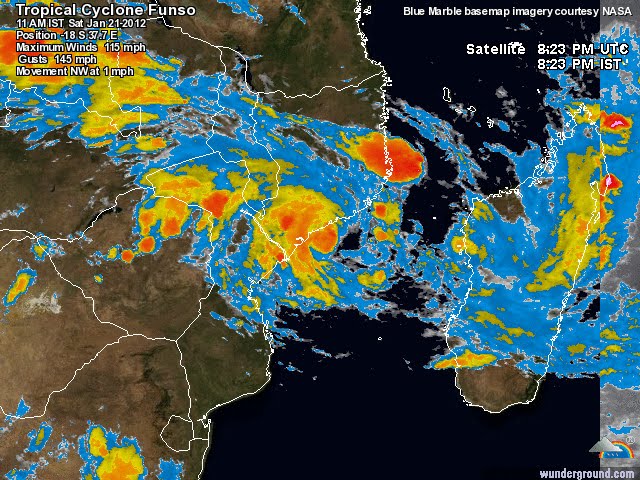
There is only one cyclone/hurricane/typhoon active on the whole globe at the moment. Unfortunately it's in our back yard.

Occasionally we have to delay a trip for a few hours due to early morning fog. Once or twice we've had to divert to another airport due to bad weather. It's not often, though, that we postpone a whole flight altogether.

Right now I was expecting to be in the village of Nensa on the banks of the Zambezi with an education development team, but instead I am sat at home in South Africa typing this update.

The last entry below detailed some weather that we had about a week ago that affected us in the east of South Africa. It seems that when that dissipated some of the moisture got sucked into another depression that was developing off the coast to the north of Mozambique and the result was another more powerful cyclone, misleadingly called Funso.
To give you an idea, two of the boxes on the map above are a little further than the length of the UK.

Currently Funso is a Category 3 cyclone but is forecast to develop into a Category 4 tomorrow (Katrina in the US a few years ago was a Category 5). Here's a map that shows rain intensity. Basically as you can see from the key, all the pinks and purples are as about as heavy rain as you can get.
The next two maps shows how quick it developed and are two days apart from each other.

All is not entirely lost though.

Mercy Air has a working relationship with a number of aid organisations (CARE, OXFAM etc) based in Maputo and we are on call to assist with natural disasters of varying magnitudes. The rain we had last week has now made it's way into the river systems and the levels are currently peaking in the lower Limpopo River Basin. They have asked us to do some survey flights to assess the situation and Paul will likely fly over early on Wednesday morning to take various NGO representatives to have a closer look.

My guess is that will be the subject of the next blog.

Paul and Cathy

18 January 2012

Rain Rain Everywhere

We've been to help in other areas a number of times when they have been hit by flooding, but now we have our very own storm come to visit us.
It is called Cyclone Dando and developed last week between Madagascar and Mozambique. It is only a category one storm but it has been raining hard continuously here for three days now and we've had the same amount of rain in three days as we usually get in the whole of January - which in itself is one of the wettest months.

Here's a pic of one of the rivers in the nearby Kruger Park.
Mercy Air has had it's issues with the weather as two large trees on the farm fell down last night, one narrowly missing the Ziessler's house.
At least we'll be alright for fire wood this winter!

I think we're due to get one more day of rain before things start to clear up. It's just like Britain!

However, one article suggests that moisture from Dando could get sucked into another depression that is forming off the coast to the north of Mozambique and create a new cyclone. This would be particularly worrying as Paul is flying a team up there this coming Monday.

Paul and Cathy

08 December 2011

More Tea Vicar?

Recently Mercy Air was given 130 Kg of Artemisia Tea and asked to take it up to a mission station in the north of Mozambique that specializes in natural medicine.

Go and weigh a tea bag - never mind, I have one here (that I prepared earlier) and it weighs 4 grams.

This isn't any old tea though and a course of 14 of these particular tea bags (56 g) taken over a week can cure Malaria. So 130 Kg of the stuff is enough to treat over 2300 people and well worth the effort of raising the money to cover the cost of flying it there.

Getting it from Durban wasn't too hard - it just arrived on a truck. Getting it to Nacala, on the other hand, was a different story. Nacala is half way back to the equator from where we are and 200 km further east than a line with Moscow.
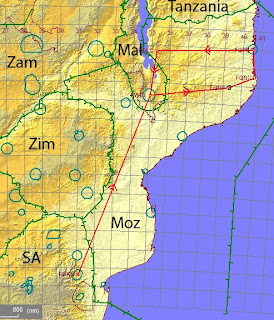
We had a plane and a pilot, all we needed was money and fuel. People in the UK, Germany, Switzerland and the USA responded brilliantly to a request for funds, raising about half the costs. A week before our intended departure some guys from Hope for Africa (www.hopeforafricamission.co.za), rang with a request for help in getting three of them to Blantyre, Malawi. As it happened Blantyre was one of the few places that had avgas, so by having them cover most of the cost of that part of the flight, we could refuel there and still get to Nacala.

So, the packing began.
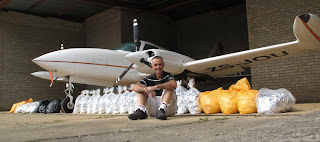
The nose, wing lockers and back of the plane full to the brim.

The total flying time from SA, via Blantyre, to the military airstrip in Nacala where we loaded the tea into a pickup truck, was 7 hours.
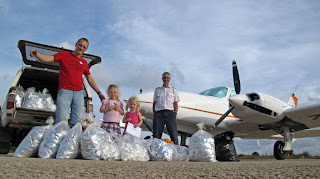
Then there was a 2 hour drive mostly on dirt roads to Memba where they are based. I wouldn't say the road was bad but on the way we passed a grader that usually shapes the roads in Africa. I guess this one lost.
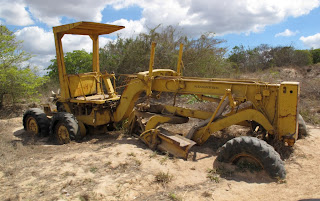
We arrived after dark and so delivered the Artemisia to various clinics the following day.
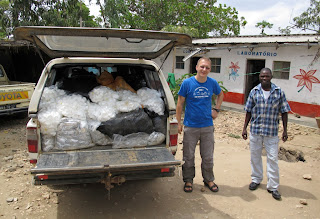
Artemisia was discovered in China and has been used for thousands of years as an effective cure for various diseases including Malaria. Martin and Simone Schumann along with Myriam Wahr, the missionaries working in Memba, have set up many rural clinics and use natural medicines, many of which they grow themselves. Unfortunately the Artemisia plant will not grow properly where they live due to bad soil and irregular rain.

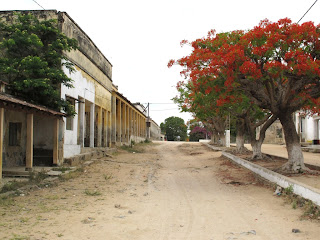
Memba itself is a real back of the beyond type of place. It was attacked three times during the war (which ended 20 years ago), but nothing seems to have been fixed since then.
This was the hospital which was left in ruins...
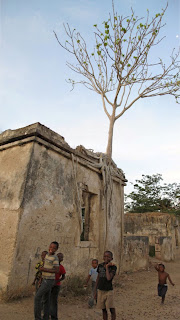
and this is one of the main streets where trees in blossom provide a temporary relief from the usual dusty monotone appearance.
Martin and Simone have built a small three roomed house (where Mercy Air helped install the electricity a year ago - http://pcm-mercyair.blogspot.com/2010/11/woken-up-by-whales-but-not-whilst.html).
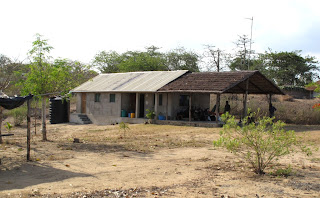
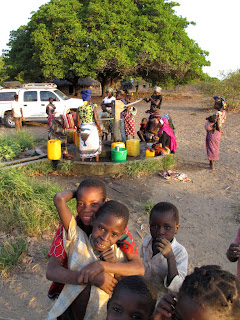
They get water from a public well on the other side of town...
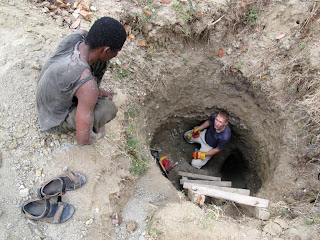
but in the mean time are digging (chiseling) their own well.
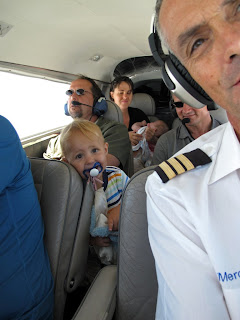
The night before I left, we got a call asking us to pick up a lady who had been ill for a couple of weeks and needed to return to SA for further tests. So on the way back I routed via Lichinga to collect her and her kids as well as the guys I had dropped in Blantyre earlier.
The flight across to Lichinga took me past some very impressive scenery that gives an idea of the ruggedness and remoteness of some of the parts of the world we fly into.
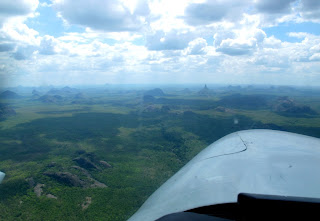
So, after 4300km (2700 miles) and 16 hours of flying, this is primarily written to thank those people who gave so freely towards the cost of this flight. Because of your generosity many other people will benefit and many of those will probably live longer than they would have done if we'd of all stood back and done nothing.

Paul and Cathy

02 August 2011

Fire!

No joke actually.

After yesterdays mammoth flight to Chimoio I had planned having an easy day today. Well that all ended at 05:30 when we were alerted to a fire in the main house at Mercy Air. We rushed round to find the house filled with acrid smoke and the living room ceiling on fire. On top of this the electricity had tripped so inside and out was pitch black with the only light being the flames.

Guests had made a fire in the fireplace the previous evening and we suspect that some soot in the chimney had ignited and found its way through gaps in the mortar and then set light to old bee hive and rats nest material in the roof, which had then spread along the eves and up into other parts of the roof.

The back of the main house is almost completely made of wood but fortunately the fire was restricted by the small space between the ceiling and the tin roof. This hadn't stopped it spreading as such, but it had prevented it getting well out of control.

We knew the fire brigade wouldn't come out to us so we had to make our own plan. This amounted to stringing a line of garden hoses together to extinguish the visible flames. After that the darkness worked in our favour as we could then see additional flames flickering through other small gaps. This now meant that we had to get a ladder and axe and break down other parts of the ceiling and walls to get access to these different areas.

All in all it took us about an hour to bring things under control and make sure everything was well and truly out. This also included taking some of the corrugated roof sheets off.
This is the scene from inside after it got light.
All the black bit in the photo above was ablaze when we first arrived.

So, not a good day at all, but one which we realise could have ended far far worse if it hadn't been for God's protection.

Paul and Cathy

One week on from the fire and a couple of pics to show progress on the reconstruction. The first was after the corrugated sheets had been taken off showing the fire damaged portions.
And the second, a day later, when the internal tongue and groove had been removed.Mercy Air staff and volunteers are doing the work as there was no buildings insurance and we expect to complete it in about a weeks time.

P n' C.

Quick Trip to Chimoio

The title of this entry is a bit misleading as you can never really have a quick trip to Chimoio. If you drive it takes you at least two full days and even if you fly it's about 3h30. If you fly there and back in a day it requires getting up very early and just making it back before dark. This was the case yesterday. To make it harder I had the runniest or noses and the sorest of throats but at least the weather was kind with blue skies all the way.

I flew three Canadian mechanics up to ASAM in Chimoio, the same place Mercy Air is building a remote base. I flew Rick up in March as he was preparing to start a mechanic school and build a workshop to help service the mission vehicles (all on his site at http://mercytechmission.com and his blog at: http://mydustyshoes.blogspot.com/2011/07/leaving-on-jet-plane.html).

This time he went with two friends, Todd and Ed who were also instructors and technicians and they will stay for up to a month. They spent a few days at Mercy Air prior to traveling up, which gave them, and Paul, the chance to do some boy shopping for socket sets, screwdrivers and other tools to equip the workshop. Despite the simplicity of the task, this still took a whole morning!

At the risk of including another, 'here's us on the way up' type photo, what else can I take a pic of to grab your attention and save this being a blog entry full of just words?
So, here's us on the way up!

Paul and Cathy

OK. I wrote this as soon as I got back and now the team have posted some photos on the net, so, I'm sure they won't mind if I plagiarise their efforts and include them below.
The boys at Vilanculos, our port of entry into Moz.

Me, not looking where I am going.

Some of the tools and manuals they took up with them.

Their home for the next month and the same tents we usually stay in when we go up there.
The Training Centre well on its way to completion.

The first motor mechanic class in Chimoio.

Putting their new found knowledge into practice.

Paul and Cathy